An AI book summarizer is most useful as a chapter-by-chapter reading companion, not as a substitute for the book. Work from an excerpt or text-bearing PDF you are permitted to use, map the chapter’s structure, generate a short account of its argument or events, and then check every important name, quotation, definition, number, and conclusion against the original. Keep the book open while you review the output.
For nonfiction, preserve the author’s claim, evidence, counterarguments, and limits. For fiction, preserve viewpoint, sequence, motivation, and uncertainty without inventing explanations. In both cases, label your own interpretation separately from what the text actually states.
Publication and evidence note: Heni Hazbay creates Summarise Visually and may benefit if readers download or subscribe. AI assistance supported Semrush research, source discovery, drafting, and editing; claims were checked against the cited sources and current project evidence. Heni authorized publication on July 15, 2026. No current-device book test, product accuracy benchmark, comprehension study, time-saving measurement, or grade outcome was performed for this guide.
What an AI book summarizer should produce
A useful book summary is a compact map back to the original. It should help you locate the chapter’s purpose, major steps, evidence, characters, or turning points. It should not flatten every kind of book into a generic list of “main ideas.”
For a nonfiction chapter, a strong result usually records:
- the question or problem the chapter addresses;
- the author’s central claim, if one is stated;
- the sequence of reasons, evidence, examples, or worked steps;
- important definitions in the author’s intended sense;
- qualifications, objections, and unresolved questions;
- the chapter’s relationship to the book’s wider argument.
For a novel, memoir, or narrative work, the useful fields are different:
- the viewpoint and time period;
- the events in their correct order;
- what each central character knows at that point;
- decisions, conflicts, and consequences;
- motifs or themes clearly supported by the chapter;
- uncertainties that the author has not yet resolved.
That distinction matters. A system can produce fluent prose while changing relationships or adding unsupported details. Research on faithfulness in abstractive summarization is a reason to verify the output, not a measurement of this app or of every modern system.
Start with a lawful, stable source
Use a copy you own, have licensed, can access through your institution, or are otherwise permitted to process. Public-domain and openly licensed books are the simplest material for experiments, but status can vary by country. Project Gutenberg’s permission guidance explains that its public-domain determinations are U.S.-focused and tells readers outside the United States to check local rules.
Do not assume that “for study” automatically permits uploading an entire copyrighted book. In the United States, Section 107 sets out four fair-use factors, and the result depends on the circumstances. UK guidance likewise describes limited exceptions and warns that copying a whole work generally would not be fair dealing for private study. This page offers a cautious workflow, not a legal conclusion. Follow the terms attached to the book, your library or school rules, and the law that applies to you.
Create a small source record before summarizing:
- title and author;
- edition, translator, or version;
- chapter and page range;
- publisher and publication year;
- the date you accessed the material;
- whether you worked from selectable text, a permitted excerpt, or a text-bearing PDF.
Edition details are not bureaucracy. Pagination, translation, chapter order, terminology, and even the text itself can differ. A summary without version information is harder to verify or cite later.
A chapter-by-chapter summarizing method
1. Set a narrow purpose
Decide what the summary is for before generating it. Preparing for a seminar, recalling a plot, learning a process, reviewing a theory, and comparing two authors require different detail. Write the purpose in one sentence.
Then set a maximum scope. One chapter or coherent section is safer than an entire long book because you can still compare the result with the source. The current project evidence does not establish full-book context or automatic chapter stitching.
2. Survey the chapter before compressing it
Read the title, introduction, headings, conclusion, captions, tables, and highlighted definitions. Note the chapter’s visible structure. For structured nonfiction, the OpenStax active-reading guidance recommends surveying headings and other signals, creating questions, reading, reciting, and reviewing. That method is useful here because the human reader identifies the chapter’s architecture before an AI system compresses it.
For fiction, note viewpoint, location, time, and scene boundaries instead of forcing the chapter into textbook headings. Record what remains ambiguous. Ambiguity is information; a summary should not turn it into certainty.
3. Prepare the material without stripping its context
If you use the iPhone workflow described by current project evidence, provide a permitted excerpt as plain text or share a text-bearing PDF. The verified PDF branch relies on extractable document text. It is not evidence of EPUB or MOBI import, audiobook transcription, book-store integration, or OCR for a scanned book.
Inspect the supplied text before continuing. Look for missing columns, broken hyphenation, headers inserted into sentences, footnotes placed in the wrong position, and equations reduced to meaningless characters. If the extraction is incomplete, fix the source or reduce the scope. Do not ask the summary to repair text it never received.
4. Request a layered result
Generate an initial result that separates rather than blends:
- a two- or three-sentence overview;
- a short outline following the chapter’s order;
- key terms or characters;
- evidence, examples, or turning points;
- qualifications and unresolved questions;
- five questions you could answer from the chapter.
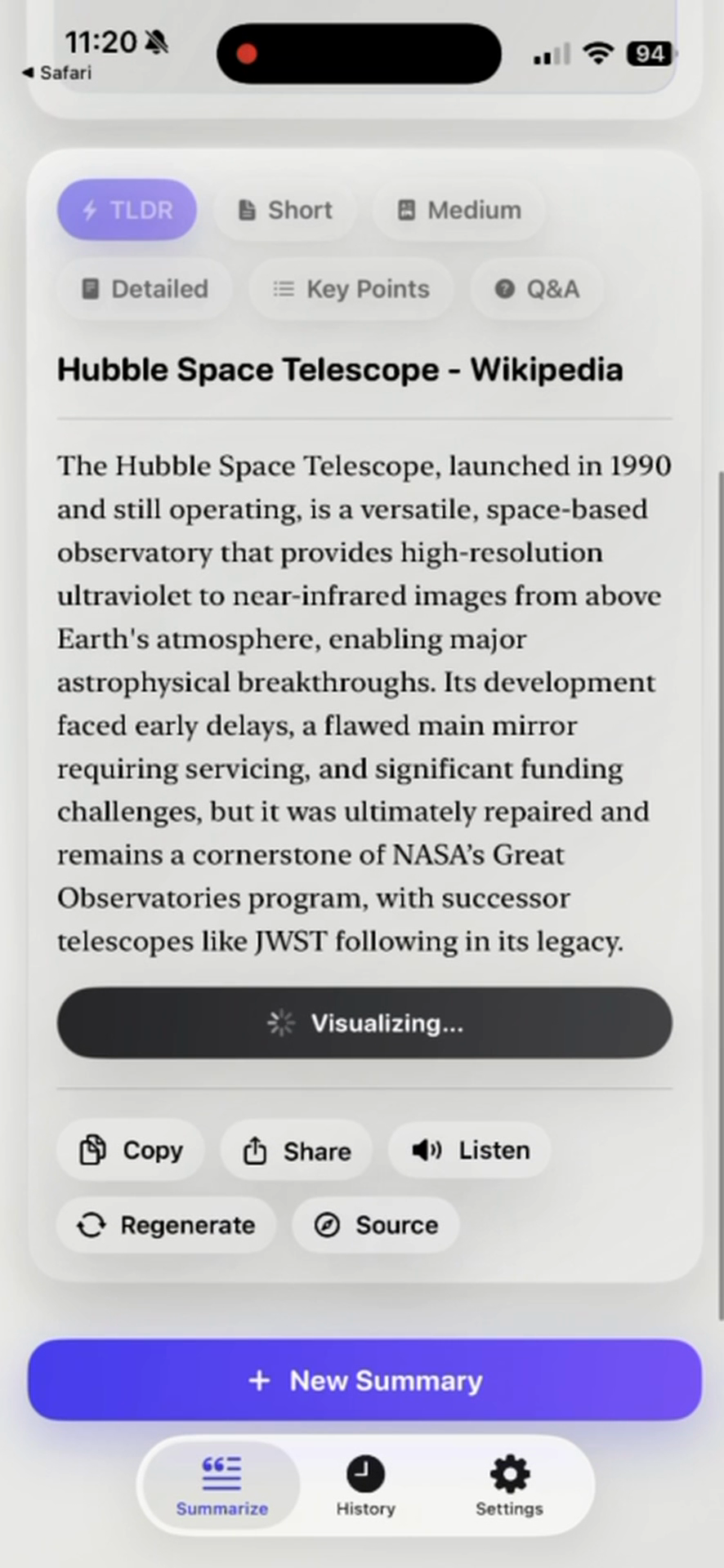
Summarise Visually currently includes Key Points and Q&A modes. That interface evidence does not prove that five questions cover a chapter or that the key points are complete. Treat the result as a draft structure.
5. Audit every consequential claim
Keep the original beside the summary. Use the process in How to check an AI summary for accuracy: split the output into checkable claims and trace each one back to the source.
For nonfiction, verify:
- names, dates, quantities, units, and formulas;
- the subject and object of every causal or comparative claim;
- whether “may,” “often,” or “in this sample” became an absolute statement;
- whether an example was misrepresented as the author’s main conclusion;
- whether a counterargument or limitation disappeared.
For narrative books, verify:
- who performed each action;
- the chronology and location;
- what a character knows versus what the reader knows;
- whether dialogue is quoted exactly or merely paraphrased;
- whether an interpretation is supported at this point in the story.
Add page or location references yourself while checking. Current project evidence does not establish automatic page citations or quotation preservation.
6. Rewrite in your own study language
After verification, close the generated result and explain the chapter from memory. Then reopen the source and correct what you missed. This creates an active review step instead of passive acceptance.
Research on retrieval and learning supports testing recall rather than relying only on repeated exposure, but that study does not show that this app improves comprehension or grades. The defensible takeaway is practical: use questions to reveal what you cannot yet explain.
7. Connect the chapter to the whole book
Maintain a simple chapter ledger:
| Field | What to record |
|---|---|
| Chapter purpose | The problem, stage, or question this chapter addresses |
| New material | Definitions, characters, evidence, events, or procedures introduced |
| Connection | What the chapter extends, challenges, or prepares |
| Verification | Pages or locations checked against the summary |
| Open questions | Unclear points to revisit in the source |
Do not merge chapter summaries into a supposed whole-book account until you have checked their transitions and contradictions. A local summary can be accurate while the combined narrative misstates the author’s broader position.
Textbook, nonfiction, and fiction need different checks
A textbook chapter often uses headings, definitions, diagrams, exercises, equations, and worked examples. Those elements require a dedicated workflow, covered in the textbook summarizer guide. A general book summary should not silently discard visual or mathematical information.
Argumentative nonfiction requires attention to evidence and scope. Ask whether the author reports data, interprets other sources, presents a historical account, or makes a normative claim. Keep those categories separate.
Fiction and memoir require restraint. Do not convert a narrator’s belief into an objective fact. Preserve uncertainty, irony, and changes in viewpoint. If the purpose is literary analysis, record the passage that supports each interpretation and distinguish your analysis from the plot summary.
Turn the checked summary into useful review material
Once the summary is verified, transform it rather than rereading it repeatedly. The Key Points and Q&A study guide explains how to use visible questions as a review aid without pretending they form an adaptive testing system.
Useful prompts include:
- Explain the chapter’s central claim without looking.
- Name the strongest evidence and one limitation.
- Reconstruct the sequence of events from memory.
- Define a key term and give the author’s example.
- State how this chapter changes the book’s direction.
- Identify one point the summary omitted but the source makes important.
Answer from memory first. Then check the chapter, not merely the AI-generated notes. Correct both your answer and the summary when they differ.
Limits and verification
The verified app route supports user-supplied excerpts and text-bearing PDFs. It does not establish EPUB, MOBI, audiobook, bookstore, or library integration. It does not establish whole-book context, automatic chapter stitching, page citations, or faithful quotation handling. Image-only book scans are not OCRed by the verified PDF branch; a separately shared image has a different OCR route, but that is not an end-to-end scanned-book workflow.
A generated book summary can miss themes, tone, foreshadowing, illustrations, equations, counterarguments, and authorial nuance. It can also sound certain when the chapter is deliberately ambiguous. The book remains the authority.
Copyright and contractual limits also matter. Do not bypass access controls, remove rights-management information, distribute substantial copied passages, or publish a generated substitute for a book. Fair use and fair dealing are fact-specific; consult a qualified professional for advice about a particular use.
Finally, a checked summary is still selective. Accuracy does not prove completeness, neutrality, learning, or fitness for an exam, publication, professional decision, or legal citation. Verify consequential details in the edition you actually used.
Final book-summary checklist
Before relying on the result, confirm that you can answer yes:
- Did I identify the exact edition, chapter, and page range?
- Am I permitted to use the material in this way?
- Did I preserve the chapter’s order and purpose?
- Did I separate the author’s statements from my interpretation?
- Did I check every important name, number, definition, quotation, and event?
- Did I review figures, equations, footnotes, and visual evidence separately?
- Did I add my own page or location references?
- Did I record omissions and uncertainty?
- Can I explain the chapter without reading the generated result?
- Will I return to the original before citing or acting on it?
If any answer is no, treat the summary as an unfinished draft. The goal is not to make a book disappear. It is to create a small, traceable aid that sends you back to the source with better questions.